Thursday, February 27, 2014

UK government commits to using the Open Document Format


While reading up on the latest Linux and Open Source software news, I came across this article:

"The United Kingdom government is taking the first steps to switch from Microsoft Office proprietary formats to ODF format, in an effort to steer the entire governmental apparatus towards a more open source world.

The proposal to switch to Open Document Format has been posted on the Cabinet Office website, which is a department of the government that supports the Prime Minister and Deputy Prime Minister and ensures the effective running of government. You can't get any more bureaucratic than this.

The document posted on the Cabinet Office website is called “Challenge: Sharing or collaborating with government documents” and explains the goal of this very controversial switch, which is sure to ruffle some feathers at Microsoft's headquarters.

“Users in this challenge include citizens, businesses and delivery partners who need to share information with government using editable documents. Users are also officials within government departments who need to share and work on documents together,” reads the UK proposal.

The note also mentions the expected benefits of such a daring move. The most important is that users (whoever they may be) won't have to buy software in order to submit documents to government officials or services due to the document format requested.

The documents that must be compliant with the Open Document Format are: Word processed texts, Spreadsheets, and Presentations. If you look closely, this is exactly Word, Excel, and PowerPoint.

There are a number of available free office suites available for download already, LibreOffice and OpenOffice being the most famous, that can save documents in this format. A number of city administrations from all over the world, including Munich, have already decided to go open source all the way.

The British government is the largest organization that has expressed its interest towards open source, although for now it is content about tackling only the problem of Open Document Formats.

It's safe to say that already a number of open source organizations have expressed their support for this decision, including The Document Foundation.

“The Document Foundation enthusiastically supports the UK Government proposal supporting the adoption of ODF 1.1 and ODF 1.2, alongside with HTML 4.01 and HTML5, CSV and TXT, for sharing or collaborating with government documents,” reads a comment submitted to the UK challenge.

Microsoft hasn't sat idle all this time. Only a week ago, the company posted a message in which it said that the adoption of ODF will increase costs, cause dissatisfaction amongst citizens and businesses, and a few other grievances.

Microsoft also proposed that both formats remain in effect, but the decision of the British government seems to be part of larger plan that has yet to be revealed." -Softpedia Linux News

While some people would have cheered over the bite this will take out of Microsoft's wallet, I am happy to see this because the use of the Open Document Format, or ODF for short, means that a switch from one software vendor to the other will be an easy implementation.

And that means that we as the consumer will have more freedom of choice.

Hopefully as more and more institutions do this, Microsoft will have to change their software writing policies to a more open solution.


Monday, February 17, 2014

Ubuntu, Linux for Chinese?


Canonical released some interesting numbers not too long ago.

In these numbers is the fact that over 1.3 million copies of Ubuntu were downloaded from China in a 6 month period of time.

The Chinese already are a large user of Ubuntu, but this is an amazing increase.

Here is the official release from Canonical:

"Its popularity has built quickly with 400,000 downloads after its first release in April 2013 and a rise to over 1,300,000 new downloads after its second release in October. That's impressive for a downloadable operating system since most consumers in China, the world’s largest PC market, as in other markets prefer to get their OS pre-installed when they buy a device", says Canonical.

Canonical continued to say, "with such strong initial growth, Ubuntu Kylin adoption is set to increase. Ubuntu already has a long standing presence in China. Canonical has been partnering for years with OEMs like Dell, HP and Lenovo to bring millions of Ubuntu pre-installed PCs to China. They are currently being sold online and across nearly 2,500 retail outlets in China".

For me personally it's a matter of pride. More and more it's becoming obvious that the open source idea has merit, and that there are huge advantages to using something like Ubuntu.

Linux in general is the operating system to watch.
-Denny

Wednesday, February 12, 2014

WattOS, an excellent light weight Ubuntu derivitive

In my never ending search for a light footed variant of Ubuntu, I came across wattOS.

I decided 3 days ago to install it and give it a try. I am delighted with it. 

It's amazingly fast and nimble, and yet I was able to install all of the software I normally use and tweak it to my liking.

The premise behind wattOS is not only nimbleness, but low energy usage as well.

Here is the about info, thanks to DistroWatch.com:

"wattOS is a fast desktop Linux distribution based on Ubuntu. Using the lightweight Openbox window manager as its default user interface, the distribution strives to be as energy-efficient as possible so that it can be used on low-specification and recycled computers."

The most surprising to me is the fact that there was no quirky new software or issues to deal with. There is new software, but it stayed out of my way and I had no need to mess with their operation.

Here's a screenshot of wattOS r7, and my screenshot:


If you would like a copy, you can get it at PlanetWatt, wattOS's official website.

Wednesday, February 5, 2014

Outernet, free wifi for all


A group of engineers, developers and support staff are looking to release "CubeSat" satellites sometimes in June of 2015.

These satellites will broadcast free wifi, and will allow you to use things like:

News and Information

    International and local news
    Crop prices for farmers
    Bitcoin blockchains

Applications and Content

    Ubuntu & OpenStreetMap
    Wikipedia in its entirety
    Movies, music, games

Educational Courseware

    Khan Academy and Coursera
    British Council's LearnEnglish
    Teachers Without Borders

Emergency Communications

    Used when cellular networks fail
    Disaster relief coordination
    Global notification system

All of this will be free to the public to use,

One of the main reasons why the group is determined to accomplish this, is an article in the "Universal Declaration of Human Rights", Article 19 which states:

"Everyone has the right to freedom of opinion and expression; this right includes freedom to hold opinions without interference and to seek, receive and impart information and ideas through any media and regardless of frontiers."

The Outernet group's official website has this to say about their goal:

"By leveraging datacasting technology over a low-cost satellite constellation, Outernet is able to bypass censorship, ensure privacy, and offer a universally-accessible information service at no cost to global citizens. It's the modern version of shortwave radio, or BitTorrent from space." -https://www.outernet.is

I love this idea. According to Outernet, only 60% of the world have access to the content available on the Internet. They want that to be 100%.

These CubeSats definetly resemble their name, here's a peek at what they look like:

And here's what they will look like from space:


As you can tell, these satellites are not very big. Which will make them much cheaper to maintain. (In my opinion)

Here's what the Outernet group has to say about these interesting satellites and the network they will work on:

"Outernet consists of a constellation of hundreds of low-cost, miniature satellites in Low Earth Orbit. Each satellite receives data streams from a network of ground stations and transmits that data in a continuous loop until new content is received. In order to serve the widest possible global audience, the entire constellation utilizes UDP-based multicasting over WiFi. Although still not common, WiFi multicasting is a proven technology, especially when the data requires only one hop to reach the recipient.

150 satellites deliver various content to WiFi-enabled devices on Earth's surface

Citizens from all over the world, through SMS and feature-phone apps, participate in building the information priority list. Users of Outernet's website also make suggestions for content to broadcast; lack of an Internet connection should not prevent anyone from learning about current events, trending topics, and innovative ideas. " -https://www.outernet.is

Outernet is asking for the public's help, with spreading this information and with donations to help the project.

If you would like to do either, check the bottom of https://www.outernet.is for more information.

Friday, January 31, 2014

Meet Replicant, Android's open source twin


In checking local Linux news, I came across a press release from Replicant.

Replicant is a "free" (or open source) variant of Android that uses CyanogenMod and can be used to power many cell phones including the HTC Dream/HTC Magic, Nexus One, Nexus S, Galaxy S, Galaxy S 2, Galaxy Note, Galaxy Nexus, Galaxy Tab 2 7 inch, Galaxy Tab 2 10.1 inch, Galaxy S 3, Galaxy Note 2, and GTA04.

This week Replicant became the equivalent of Android Jelly Bean, (or version 4.2).

Here's a little about CyanogenMod:

"CyanogenMod (pronounced sigh-AN-oh-jen-mod), is a customized, aftermarket firmware distribution for several Android devices (See above for supported devices & how to install CyanogenMod on said devices). Based on the Android Open Source Project, CyanogenMod is designed to increase performance and reliability over Android-based ROMs released by vendors and carriers such as Google, T-Mobile, HTC, etc. CyanogenMod also offers a variety of features & enhancements that are not currently found in these versions of Android." -http://www.cyanogenmod.org/about

I have heard the question "Why make Replicant?" asked on a few open source/Linux boards, and I think there are 2 good reasons behind it. 

Number one has to be that since it is now the most used operating system on the planet, it's good to keep an open source variant around in case Google decides to lock us out and charge an arm and a leg to develop on it. 

The second reason is that once you have an Android "Replicant" you can fork it to fit your specialized needs without stepping on Google's toes or breaking laws.

If you would like more information on Replicant, here are some links for you:

Replicant's official website: http://www.replicant.us/

Replicant's Wiki pages: http://redmine.replicant.us/projects/replicant/wiki

CyanogenMod;s official website: http://www.cyanogenmod.org/

Although you won't notice much if any difference in screenshots between Replicant and Android, I thought I would include them anyways. (Because pictures make for a sharper looking article, and I spent the effort digging them up.)


Monday, January 27, 2014

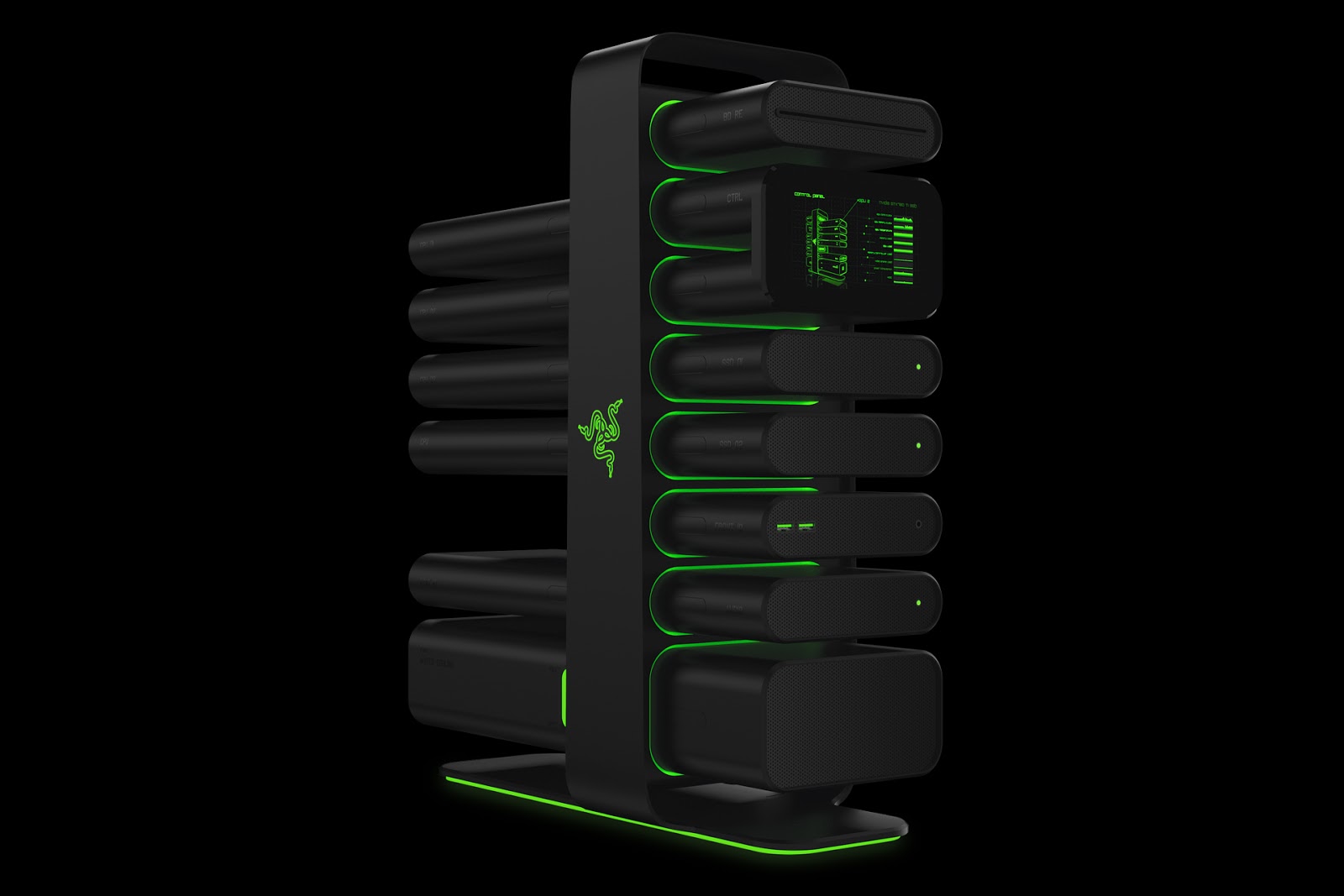
Project Christine, the world's most modular PC design


Project Christine is an all new way to look at "building" your own computer. It's not uncommon in the gaming computer world to do so.

Most people haven't even given building their own PC a thought, or are intimidated by thoughts of 1500 dollars in computer hardware sparking and shorting out, rendering it a pretty looking doorstop.

Razor has come up with the solution. A totally modular PC design that fits together as easily as Lego blocks do.


Here's what Razor has to say about Project Christine:

"Project Christine is a revolutionary new concept design that allows users to build and customize PCs in any configuration without any prior technical knowledge.

Choose any module on-the-fly in any combination, whether it’s the CPU, memory, graphics card, storage or power supply module, and simply plug it in.

The PCI-Express architecture of Project Christine automatically syncs the components.

As new PC technology evolves, Project Christine can evolve with it. Need more graphics processing power or storage? Easy – a user can slot-in additional graphics modules and add more storage by either swapping-out the existing storage drives or adding more modules.

The modularity of Project Christine makes it perpetually customizable, helping eliminate the need to replace entire systems.

Each sealed module is entirely self-contained and features active liquid cooling and noise cancelation. With this design, Project Christine’s components can be safely overclocked without voiding warranties." -http://www.razerzone.com/christine

These next 2 pictures show how the modules slide in and out, and some of the neat extras the smaller front modules will give you, like a read out on how your system is doing performance wise.


If you are interested, there is a short YouTube video here: http://www.youtube.com/watch?v=G0K41ZWd-vo

I love this idea. Computers today are thrown away as soon as they are too slow.

Being modular, you wouldn't throw the whole computer away, you would just replace the module that was no longer able to fulfill your needs.

Sunday, January 26, 2014

Shotwell gets a new developer

If you are a Linux user and have a large photo collection then you are probably familiar with Shotwell.

Shotwell can:

* import photos from folders or from your digital camera or phone
* automatically group photos taken at the same time, use tags and ratings to organize your phot0 collection.
* rotate, crop, reduce red-eye, and adjust the exposure, saturation, tint, and temperature of each photo.
* publish and share photos

Because of the lack of development in Shotwell, Yorba the creator of Shotwell has handed over development to the Elementary OS team.


"I've been talking to Jim Nelson (President of Yorba) about Shotwell for a while now and here’s the quick and dirty: Shotwell needs a new maintainer. Ubuntu has the Gallery app, Fedora has GNOME photos, and Yorba just doesn't have the resources anymore to maintain Shotwell. Their focus is on Geary. So that pretty much leaves us or an unknown to take up the mantel"

"Jim seems really excited about the idea of Shotwell becoming a part of our community. He thinks we have the talent and the vision to bring it up to date and make it into a really great app". -Daniel Foré, Elementary OS project leader.

In case you are unfamiliar with Elementary OS, it's an Ubuntu based distro with a Mac OS X feel.

I think this is great. Instead of letting Shotwell die like many other apps have done when they have no development resources, Yorba is passing it on to a community that will spend the time and talent to keep it a very useful application.