I have been trying to find a suitable replacement for Gnome 2, slated to be off the repos in Ubuntu in 2013.
I came up with nothing.
I do see a glimmer of hope from a post made at http://askubuntu.com/questions/51470/is-gnome2-x-going-to-be-caompletely-obsolete-from-all-linux-distro
I have tried every desktop environment in the repositories, and some not in the repos, like AWN.
I must admit, if there were only Unity or Gnome 3 to choose from, I would choose Gnome 3.
XFCE is nice, and very "Gnome 2"-ish. But it has some quarks and ties to Gnome 2 that make it iffy for me. I hope XFCE survives long past Gnome 2, because it is better than Unity and Gnome 3 combined.
Having had no luck finding a KDE 4 minus all the glitz and extra junk, KDE 4 is out for me as well. (I miss simpler older KDE 3. KISS!)
To those of you who are going to comment that I could remove the junk, keep in mind that I am writing for the person who just turns it on and is new to linux, and it's desktop environments.
I hope that Gnome 3 will grow, because the direction that Unity is going is wrong.
A person on the Ubuntu forum pages said "How long will you stand still?"
I tell you that if i stand still while you walk backwards with Unity, I am at a better position.
In closing, this is of coarse my opinion, but I believe it also accurately portrays the strongly negative feelings for the currently offered Unity and Gnome 3, by a large percentage of the Ubuntu user base.

A passion for Linux, a passion for open source, a passion for freedom
Saturday, August 6, 2011


Thursday, August 4, 2011
Unity, slightly less annoying.
I absolutely hated Unity to the point of writing some slightly heated stuff on the Ubuntu message boards on the net.
I have to admit that although I am, and was right about Unity not being very user friendly, I do see the Ubuntu team(s) working to make it better though, and hopefully they have heard our voices.
The main pet peave for me is that the min max and close buttons belong on the right, and in that order, and should be an option (without going into gconf-editor) for the end user immediately, if not the default setting.
The world is used to and likes those buttons where I mentioned they should be, and shouldn't have to change because someone on one of the Ubuntu team(s) or someone at Canonical thinks that's the way it should be.
Just my rant on an otherwise beautiful operating system. I still love Ubuntu,
I just want Unity developers to keep in mind that Unity should fit the user, not the user fitting Unity, which is ridiculous.
I have to admit that although I am, and was right about Unity not being very user friendly, I do see the Ubuntu team(s) working to make it better though, and hopefully they have heard our voices.
The main pet peave for me is that the min max and close buttons belong on the right, and in that order, and should be an option (without going into gconf-editor) for the end user immediately, if not the default setting.
The world is used to and likes those buttons where I mentioned they should be, and shouldn't have to change because someone on one of the Ubuntu team(s) or someone at Canonical thinks that's the way it should be.
Just my rant on an otherwise beautiful operating system. I still love Ubuntu,
I just want Unity developers to keep in mind that Unity should fit the user, not the user fitting Unity, which is ridiculous.
Monday, July 25, 2011
Celestia, Your gateway to the stars

I have been using Celestia since the beginning of the decade.
It is an excellent tool for letting you take a 3d look at the universe.
This is what the creator(s) of Celestia have to say about the program:
"Welcome to Celestia
... The free space simulation that lets you explore our universe in three dimensions. Celestia runs on Windows, Linux, and Mac OS X.
Unlike most planetarium software, Celestia doesn't confine you to the surface of the Earth. You can travel throughout the solar system, to any of over 100,000 stars, or even beyond the galaxy.
All movement in Celestia is seamless; the exponential zoom feature lets you explore space across a huge range of scales, from galaxy clusters down to spacecraft only a few meters across. A 'point-and-goto' interface makes it simple to navigate through the universe to the object you want to visit.
Celestia is expandable. Celestia comes with a large catalog of stars, galaxies, planets, moons, asteroids, comets, and spacecraft. If that's not enough, you can download dozens of easy to install add-ons with more objects."
Here are some of the pictures I have taken from my own Celestia usage:

ISS coming over the sunrise of Earth

Mars Odyssey overlooking Mars

Neptune and it's moon Proteus aligned together and facing the Sun.
I personally like the verbose information option, and I like to use the ] key to make as many stars visible as possible, although for the images here I didn't, to keep them from being overly bright.
If you are interested in this program for Windows, it is available at the Celestia website, under the download tab, which is available here:
http://www.shatters.net/celestia/
If you would want the program for Ubuntu, then I suggest using synaptic package manager.
You will want celestia-gnome, celestia-common and I also suggest celestia-common-nonfree, or some planets and the moon will have no texture. (I.E. Mars will be a simple colored sphere.)
For other versions of Linux and Mac OS X, the Celestia website can get you started on the right path, if you don't have a package manager for your distro, or if your distro doesn't have the package available yet.
I personally put a copy onto cd and gave it to my old high school, It's a great way to get kids interested in astronomy.
Saturday, July 2, 2011
Creating ISO images in Ubuntu
I have been looking for a tool for a while that would allow me to create,
open and edit ISO's on the fly as I saw fit.
I am still looking for this program, but I accidentally stumbled upon the best ISO creator I have seen yet for Ubuntu.
It's simple, already installed Brasero.
I don't burn CDs, or rip audio files from them, so I haven't really messed with Brasero until now.
It doesn't edit or open ISO files, just so I don't confuse the matter.
To make an ISO using Brasero, first you must choose "Data Project" from the Brasero main screen.
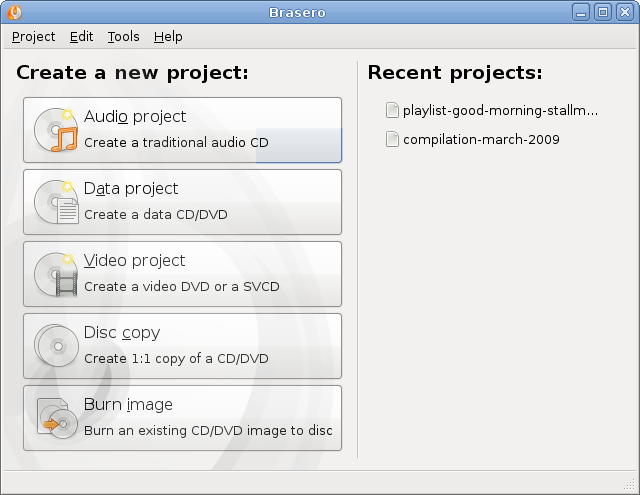
If there is no blank CD in the drive, then Brasero might have chosen on the very bottom 'Image File: "/home/(your user name)/brasero.iso"'
If this is the case, then all you have to do is drag the files you want onto Brasero, and then choose burn.
If it doesn't give you the "Image File:" option on the bottom, you can click the down arrow to the right of the bottom field to choose the option you want.
(P.S. the "/home/(your user name)/brasero.iso" will change to whatever username you have chosen upon installation of Ubuntu, so mine would look like this: /home/denny/brasero.iso.)
open and edit ISO's on the fly as I saw fit.
I am still looking for this program, but I accidentally stumbled upon the best ISO creator I have seen yet for Ubuntu.
It's simple, already installed Brasero.
I don't burn CDs, or rip audio files from them, so I haven't really messed with Brasero until now.
It doesn't edit or open ISO files, just so I don't confuse the matter.
To make an ISO using Brasero, first you must choose "Data Project" from the Brasero main screen.
If there is no blank CD in the drive, then Brasero might have chosen on the very bottom 'Image File: "/home/(your user name)/brasero.iso"'
If this is the case, then all you have to do is drag the files you want onto Brasero, and then choose burn.
If it doesn't give you the "Image File:" option on the bottom, you can click the down arrow to the right of the bottom field to choose the option you want.
(P.S. the "/home/(your user name)/brasero.iso" will change to whatever username you have chosen upon installation of Ubuntu, so mine would look like this: /home/denny/brasero.iso.)
Friday, June 24, 2011
UNetbootin - USB key iso installer
UNetbootin is a tool for installing live Linux iso files to your usb thumb drive, as is stated on their website at http://unetbootin.sourceforge.net:
"UNetbootin allows you to create bootable Live USB drives for Ubuntu, Fedora, and other Linux distributions without burning a CD.
It runs on Windows, Linux, and Mac OS X.
You can either let UNetbootin download one of the many distributions supported out-of-the-box for you, or supply your own Linux .iso file if you've already downloaded one or your preferred distribution isn't on the list."
I personally like to use it for my usb key, with something that already has flashplugin installed and is fairly rounded out, like Simply Mepis.

If you are interested in the program, you can download it here:
http://unetbootin.sourceforge.net/
Or If you have a Linux distribution like Ubuntu, you can use a package manager, or from terminal you can install it via apt: (sudo apt-get install unetbootin).
"UNetbootin allows you to create bootable Live USB drives for Ubuntu, Fedora, and other Linux distributions without burning a CD.
It runs on Windows, Linux, and Mac OS X.
You can either let UNetbootin download one of the many distributions supported out-of-the-box for you, or supply your own Linux .iso file if you've already downloaded one or your preferred distribution isn't on the list."
I personally like to use it for my usb key, with something that already has flashplugin installed and is fairly rounded out, like Simply Mepis.
If you are interested in the program, you can download it here:
http://unetbootin.sourceforge.net/
Or If you have a Linux distribution like Ubuntu, you can use a package manager, or from terminal you can install it via apt: (sudo apt-get install unetbootin).
Tuesday, June 7, 2011
Radio Tray: A Shoutcast Linux app

Radio Tray is an online radio streaming player that runs on a Linux system tray. Its goal is to have the minimum interface possible, making it very straightforward to use.
Radio Tray is not a full featured music player, there are plenty of excellent music players already. However, there was a need for a simple application with minimal interface just to listen to online radios. And that's the sole purpose of Radio Tray.
Radio Tray is Free Software, licensed under the GPL.
Features
plays most media formats (based on gstreamer libraries)
bookmarks support, with sorting
easy to use
supports PLS playlist format (Shoutcast/Icecast)
supports M3U playlist format
supports ASX, WAX and WVX playlist format

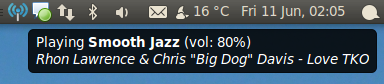
*Preceding images and information about Radio Tray from the Radio Tray website:
http://radiotray.sourceforge.net
I personally am a fan of the program because of it's minimilistic nature.
I set it to start automatically. (I add it to System > Preferences > Startup Applications on Ubuntu.)
A station i suggest is anything from the Sky.com series, including their awesome 80's station. I also like Highway 181.
Here are the addresses of my favorite channels:
181.fm Classic Hits - http://sc-rly.181.fm:80/stream/1094
977 Classic rock - http://icecast3.977music.com/classicrock
977 80's - http://icecast3.977music.com/80s
Sky.fm 80's - http://listen.sky.fm/public3/the80s.pls
Sky.fm 70's - http://scfire-dtc-aa03.stream.aol.com:80/stream/1076
And my favorite, a channel from 181.fm. An excellent classic country station:
http://38.107.220.164:8018
If your interested, you can download Radio Tray here:
http://radiotray.sourceforge.net
There is no apt-get option (or synaptic, for that matter) available for this program as of Ubuntu 10.04/10.10, but their is a .deb package that will work just fine for Ubuntu.
Wednesday, June 1, 2011
Watchtower Library 2010 in Ubuntu under Wine, Updated...

Their have been enough updates to my Watchtower Library 2010 in Ubuntu article to warrant an update notice. the original article including all the updates is available Here.
The article solves problem with the Library not running, and the blocks instead of text error.
I hope this is informative and helpful, and if there is any questions you can contact me via dennygoot@gmail.com.
Subscribe to:
Posts (Atom)